Monday, May 26, 2014

American Orchid Society Show
The Orchid Society of Minnesota held a spring show "A Growing Obsession" April 30th through May 4th. Oncidiums and Phalaenopsis dominated displays, Encyclias and Lycaste also dotted presentations.


The fluorescent lighting and spot lights played havoc with photography. I believe I still took some good photos for your enjoyment. I bought a couple of rupicolous laelia species restarting my collection.


Rosy oncidium

One of many phalaenopsis
Pretty pink
The photo does not capture the gold rim effectively.
Classic white
Large cattleya
Beautiful Lycaste
Purple-black Vanda
Attractive ladyslipper 
Nice cluster of cattleya flowers
Yet another cluster.


Really enjoyed the show and hope you enjoyed the photos!

Friday, May 23, 2014

Daffodils


Daffy-down-dilly
Has come to town
Wearing a yellow petticoat
And a pretty green gown
Daffy-down-dilly

I prefer daffodils as harbingers of early spring over other bulbs. People often select tulips but they are neither as vigorous or persistent as daffodils. Hybrid tulips are prone to animal damage often flowers are snipped and eaten as they bloom. Daffodils never fail to cheer up my soul. Their bright colors accent early greening gardens.

With proper selection of varieties daffodils can accent your garden for months. They can be forced to bloom indoors and grow well in pots.

On May 3rd I visited the Daffodil Society of Minnesota show. I present pictures from that display, I do not include names of varieties as some are collections, I want to spark your curiosity to learn more thru DSM and the American Daffodil Society.
Show tables with awards
Collection of three cultivars
Trumpet-cupped daffodils, the greenery accents the collection holds the stems in place.
Multiple collection
On white wings
Beautiful yellow with white accents
Graceful Small-cupped daffodils 
Three of one cultivar
A Poeticus variety
Double daffodil, more than one flower to a stem.
Fancy, orange rim on yellow.
Small yellow corona, full-formed white perianth segments.
Subtle flower
A bold white daffodil

Striking color combination.
Pink cup, more shade more pink

Another multiple
Classic


A woodland or meadow planting of daffodils en masse is a site to behold.
In Minnesota meadow plantings are difficult as grasses tend to be too vigorous and tall.


Hope you enjoyed and are encouraged to plant daffodils!


Sunday, May 18, 2014

Finally Spring has arrived!


April showers wet, wet, wet! May flowers and more.


To the right is Tulipa tarda a species tulip from Central Asia. It goes in subalpine meadows, talus fields and slopes in full or partial sun. Unlike hybrid tulips it is persistent and reseeds. I've been told it tolerates Black Walnut tainted soils.


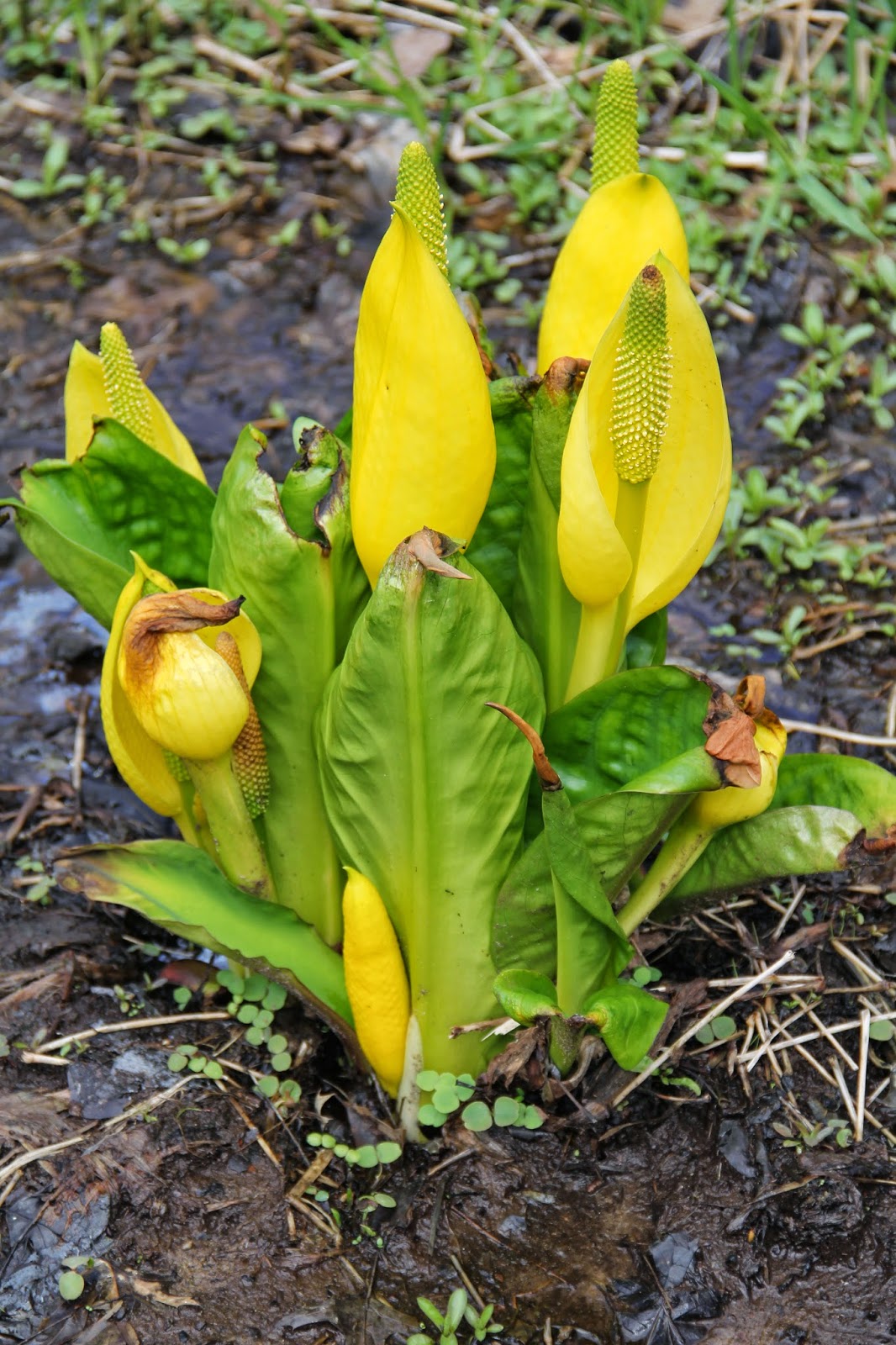
I attended the opening of Gardens of Rice Creek on May 3rd, the Skunk Cabbage was blooming.

This is Western or Yellow Skunk Cabbage. It is noted for attracting pollinators and repelling varmints such as squirrels and rabbits. 

It loves swampy wet ground and was blooming near the flooded banks of Rice Creek.
The owner of Gardens at Rice Creek was showing guests her growing collection of cold hardy Rhododendrons. She had on hand seedlings of crosses made from her cultivar collection.

In my garden a green-leaved white flowered selection of Rhododendron ledebourii was blooming profusely. This shrub spent the winter protected from cold and dessicating winds under a six foot snow drift.

Rhododenron ledebourii


Siberian Iris seedling

This Siberian Iris seedling has great promise. Its three years old, I hope to see it bloom for the first time. You probably cannot tell from this picture but it germinated and has been growing on the edge of a rock garden and sidewalk. In the summer months, especially in droughty August with air temps in the high 90s the radiated heat from the sidewalk was intense, this seedling showed no damage. Could this grow well in arid or southern climates?

Asarum canadense, Canadian wild Ginger is a beautiful native groundcover for partial to full shade.


Wild ginger unfolds


Peonies erupt with reddish foliage which eventually turns green as it matures and begins to bud. Last year the season was aborted by days of strong winds and rains.

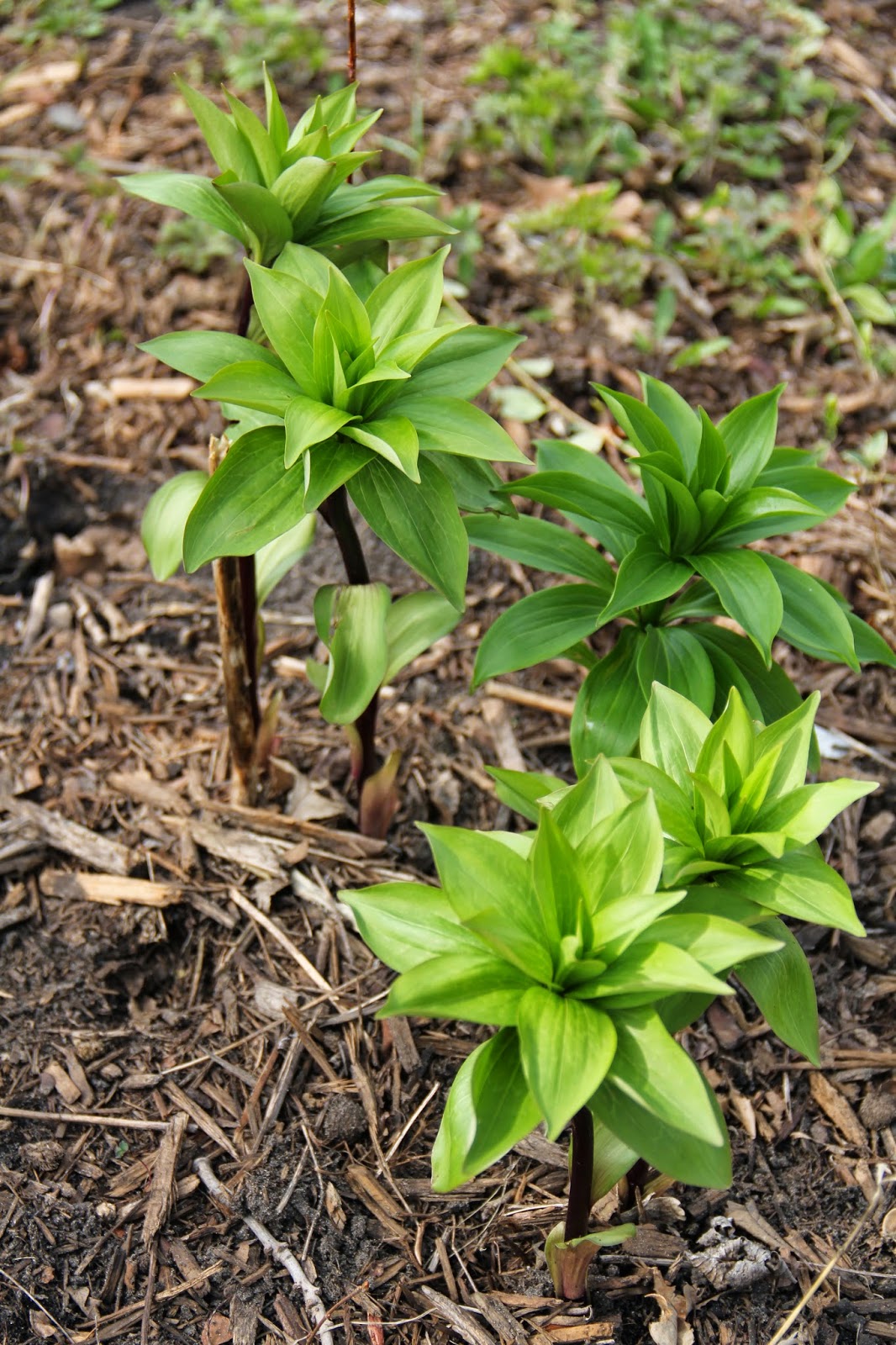
Martagon lilies quickly shoot up and unfurl their foliage.


Northern Bush Honeysuckle

Northern Bush Honeysuckle takes its time to leaf out. Another underrated native shrub, prized by the highway department and underutilized by the gardener.


Variegated with blue flowers


"Bowles Variety" periwinkle, Vinca minor is an evergreen groundcover for dry shady areas.


Can't wait for the taste of rhubarb. Sauce, cake, cookies, and pie, especially Rhubarb Custard Pie my favorite birthday treat!

I love springtime!

Monday, March 31, 2014


Sustainable Gardening


But I'm frightened for the children
That the live that we are living is in vain
And the sunshine we've been waiting for
Will turn to rain
                             The Story In your eyes
               Moody Blues

In my brief lifetime the population of earth, roughly 4.3 billion when I was born has increased to 7.3 billion today. It has nearly doubled from my childhood. It took millennia for the population to get to 4.3 billion and as it’s been explained to me since I was a schoolboy population growth is exponential.


I talked about sustainable gardening recently to a large group who garden in the Laurentian Mixed Forest. The North Woods, transition from the Big Woods, Eastern Broadleaf Forest to the Northern Boreal Forest, lakes, bogs, glacial till, and rock covered by conifers and hardy broadleaf forest, USDA Zone 2 - 3.

We discussed the sustainability mandate; our need to act since we are outstripping our natural resources faster than they are created, the need to create quality of life versus a high standard of living. Gardeners add function and beauty to our landscapes; we need to use basic sustainable gardening practices in our efforts.

I encouraged gardeners to work with nurseries and designers to create a regional gardening practice based on native plants versus hardy plants from the wholesale gardening catalog.


We reviewed gardens designed from nature; creating, adapting native plants, renovating and rejuvenating local plant communities. Avoiding fragmentation of the environment and creating corridors for the movement of wildlife.


The final piece was on plant selection and here I went to my list of favorites from this biome. I am always astounded by the public’s lack of knowledge of our native plant communities. I showed my audience sources of native plant information and went through selected canopy, sub-canopy, forbs and groundcover plants. I mentioned how they could be utilized, for example, as turf replacements or rainwater garden selections, adapting plants to the natural landscape. Restoring what was lost, rejuvenating ecologies damaged, conserving threatened ecosystems.


I also told them to embrace the bog. These are often drained or filled for agriculture or another human use. A number of years ago I witnessed a northern bog maybe 30 yards in diameter. I was attracted by the Northern Blue Flag blooming. The site was full of carnivorous plants, colonies of sundew and pitcher plant surrounded by either cranberry or lingonberry, a varied beautiful microcosm.


I was pleased with the response to my presentation as gardeners talked of using Northern Mountain Ash, Northern Bush Honeysuckle, Bearberry as groundcover and replacing Barberry with native shrubs.  In the future I hope to see some outstanding examples of LMF native gardens.


Here is a partial list of plants we discussed:'


White Pine     Pinus stobus
Balsam Fir     Abies balsamea
Northern Mountain Ash     Sorbus decora
Hawthorn     Crataegus - various
Mountain Maple     Acer spicatum
Juneberries     Amelanchier - various
Labrador Tea     Rhododendron groenlandicum
Northern Bush Honeysuckle     Diervilla lonicera
Lowbush Blueberries     Vaccinium angustifolium
Bearberry     Arctostapylos uva-ursi
Bunchberry     Cornus canadensis
Arctic raspberries     Rubus x stellarticus
Northern Blue Flag     Iris versicolor
Northern Pitcher Plant     Sarracenia purpurata
Roundleaf Sundew     Drocera rotundifolia


Tuesday, February 18, 2014

2014 St. Paul Winter Carnival Orchid Show


Braving a winter blizzard thousands attended the St. Paul Winter Carnival Orchid Show. The event ‘Escape to the Tropics’ hosted at the Marjorie McNeely Conservatory at Como Zoo was sponsored by the Orchid Society of Minnesota. White-out conditions did not deter growers, exhibitors, and orchid lovers from enjoying the beauty and diversity of the family Orchidaceae. Once considered rare and exotic this large exhibit displayed their continuing burgeoning popularity.


In the 70’s I collected a number of Laelia species; anceps, flava, sincorana, perrenii, tenebrosa and purpurata. Either originating from Mexico or Brazil they have been taxonomically reclassified as part of the Cattleya Alliance. I preferred to grow what are now called rupicolous laelia from Brasil, these species are rock lovers. They bloomed profusely under lights in my basement or on a windowsill.


I also drafted construction drawings (in one of my work lives I did architectural design and drafting) for a bermed cool orchid greenhouse to house a Laelia and Cymbidium collection.

The show performed magic and I daydream of recollecting rupicolous Laelia and building Wardian cases for their display. Are there any laelia lovers willing to trade for rare dwarf Siberian Iris?  
Well so much for dreams, here is some eye candy for those with cabin fever!  These species and cultivars pictured are from the Cattleya Alliance group of orchids.


Bearberry

Kinnikinnick

Arctostaphylos uva-ursi
Mealberry, Hog Cranberry, Sandberry
As a seventeen year old boy I spent a month canoeing and hiking the Boundary Waters Canoe Area and Quetico parks, my first exposure to the Northern Boreal ecosystem. It was a profound experience and my first opportunity to view boreal groundcovers such as Bearberry Arctostaphylos uva-ursi, Lowbush Blueberry Vaccinium angustifolium and Bunchberry Cornus canadensis.
Today Bearberry is one of my favorite groundcovers and plays a prominent part in my garden. I have utilized Bearberry in rock gardens and around the base of garden sculptures. One of my spring projects is to build a hypertufa sandcastle; Bearberry will play an important role. Bearberry can be placed along roadsides, driveways and sidewalks as it can tolerate winter salt.
Kinnikkinnick has all the characteristics for sustainable gardening: low maintenance, disease and insect resistance, drought and salt tolerant, deer and rabbit resistant and tolerant of wind and dry slopes. Even with all these wonderful characteristics Bearberry is relatively unknown and underutilized in my region. I recently talked about rock gardening and showed a slide of Bearberry to a group of gardeners and none could identify the plant.  Much of my area soils are a sand-plain, deposited by the glacial river Warren, this environment is ideal for Bearberry. Utilized as erosion control it binds and stabilizes sand dunes.
A low growing evergreen shrub of erect branching twigs which emerge from long flexible prostrate stems.  Intricately branching runners wind through crevices it often forms mats up to 3 feet wide and can travel 15 to 60 feet. The leaves turn burgundy red in the fall. Bearberry is sensitive to overhead watering, excessive leaf wetting turns leaf black and promotes dieback.
Fragrant, white and pink tingled bell-shaped flowers are borne in May followed later in the season by red berries. Birds love them a little mealy for humans.
Bearberry's stunning red stems are studded with small, glossy, evergreen leaves similar to another circumboreal groundcover Lingonberry, Vaccinium vitis-idaea which is a bog plant. It thrives within USDA zone 2-5, best protected by snowcover.
Bearberry is most often found growing on a hot, sunny slope or level area where the soil is well-drained, Ph range 4.5 to 7. I have found Bearberry growing on open rock outcroppings, under a canopy of Northern Red Oak, Big-tooth Aspen and pines of the northern boreal forest. Alongside an understory of shrubs; Juneberry, Hawthorn, Northern Bush Honeysuckle and Three-toothed cinquefoil Potentilla tridentate. It’s an excellent groundcover companion of Lowbush Blueberry Vaccinium angustifolium, Velvet-leaf Blueberry Vaccinium myrtillioides, Wintergreen Gaultheria procumbens and Bristly sarsaparilla Aralia hispida.
I plant Bearberry about 24” apart and mulch with sawdust or turkey grit lightly to discourage weeds until they meld together. You can pinch for compact growth. Do not water or fertilize excessively.
A number of Bearberry selections are available, from the east coast ‘Massachusetts’ is a medium-sized cultivar. It produces large quantities of fruit. From the coastal mountains of the northwest comes ‘Point Reyes’ more heat and drought tolerant than other forms. ‘Vancouver Jade,’ by the University of British Columbia Botanical Garden is a fast growing plant with large glossy leaves. ‘San Bruno Mountain’ produces large fruits and thick, shiny foliage with a low spreading form. ‘Emerald Carpet’ may be more shade tolerant. ‘Woods compact’ or ‘Red’ is a dwarf variety with large fruit and reddish autumn foliage. ‘Big Bear’ has large, dark green leaves and big red fruits. We appear to lack selections for continental climates, an opportunity for an entrepreneurial horticulturalist.
This is a rewarding groundcover for poor soil, tough sunny areas. I highly recommend this boreal green wonder.