Saturday, November 15, 2014

Oak of woodland and savanna

The area I live in was once dominated by oak woodland and savannas surrounding large wetlands, an ecosystem maintained by fire. Today many wetlands have been drained and the fires are suppressed. Large oak woods have been cut down and burned for development. Still remnants of great oaks persist and are never more prominent than in Fall color.

White, Bur, Red and Northern Pin Oak giants are slowing being lost to the ravages of old age and neglect. These are replaced by many varieties of maple and exotic ornamental trees in residential and commercial lawnscapes. These are easy to care for, lacking the large persistent leaves and acorns of oaks. Their scale works in small lots unlike the parkland often required for towering oaks.

Many of our eastern broadleaf forest oaks are slow growing reaching great age. They transcend our small lives outliving many generations.  They average two to three hundred years old, some living to four hundred and fifty years or more. A Bur Oak can be one hundred and thirty feet tall and as many wide. These trees require respect!


Oak wood in late morning sun.


Towering oak, wider than tall, in parkland.


Premier North American hardwood.
Majestic stand in morning light.

Basking in late afternoon sun.

Proud to be a tree hugger!

Sunday, September 28, 2014

Interstate State Park, Taylors Falls MN


This is the first post discussing famous places of scenic beauty, garden design and inspiration from nature.

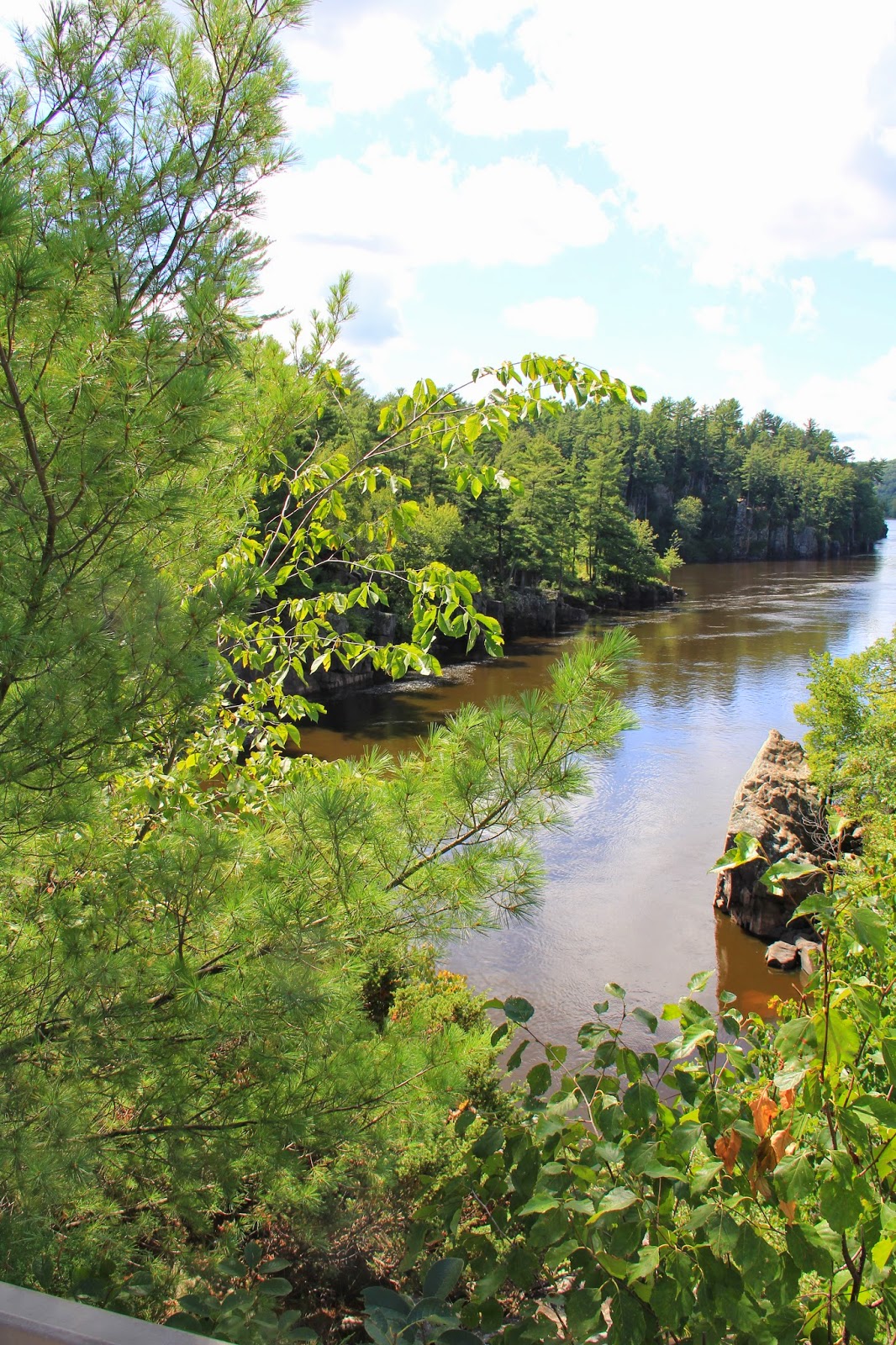
A small park on the western shore of the St. Croix River at the south edge of Taylors Falls it’s full of beauty everyone can appreciate; towering rock, deep flowing water and a mix of broadleaf and boreal forest.  Found within The Dalles of the St. Croix the area is rich in geological, ecological and human history.
Bedrock of basalt lava flows filled a rift valley are over 1.1 billion years old. Sandstones deposited from tropical seas covered the basalt. The current topography was transformed by glaciers.

Here the St. Croix River flows through a valley over a mile wide. The river at this point is typically 70 feet with pools to 100 feet deep. A plaque in the park mentions the trail is 200 feet under the surface of Glacial River St. Croix which quickly reduced Glacial Lake Duluth (current remnant Lake Superior). The main feature of the park is the potholes created by circular erosion of material by the powerful flow of water. Some have been excavated and found to be 60 feet deep, the world’s largest potholes.


Just north of the park is St. Croix Falls Dam which drowned the rapids at the top of the dalles. This hydroelectric plant providing energy for the Twin Cities has recently been supplanted by connection to the Manitoba hydroelectric power grid. Originally a dam was proposed for a lumber mill and transporting timber south. But climax white pine forests were quickly cut and not restored, the timber industry collapsed as the dam was finished. Tourism is the primary industry today. Does the dam serve any purpose? Is restoration of the rapids possible? (See The St. Croix Dam a Fatal Blockage published by Macalester College.)

In 1771 in a great battle at the rapids portage the Ojibway wrested control of the Upper St Croix valley from the Lakota and their allies the Fox. This valley now comprises the St. Croix National Scenic Riverway, one of the original eight National Wild and Scenic Rivers. www.nps.gov/sacn


The park marks a transition from mixed deciduous hardwood to boreal ecologies. This area has been seriously altered through human intervention. The wild demand for timber destroyed the climax White Pine-White spruce-Aspen forest of pre-european settlement. Red Oak-Sugar Maple-Basswood forest has supplanted and dominates surrounding lands. The cliffs and talus slopes are covered with pine and cedar.


We can get inspiration for our gardens from nature in the park.

Much of the area is monumental in scope the scale creates wonder and awe. The river can inspire a water gardener to develop a plan modeled on the river. Replacing the dam, long swift rapids of tumbling water plunge into the deep pools of the basaltic canyon.  Depending on finances a gardener could recreate the river course on a god-like human perspective or with more expense on a half-human scale. Rather than using glacial or river boulders we could use trap rock or something of dense basaltic character. Many photos are taken from a rocky promontory in the park on the Minnesota side. It allows excellent views up and down the dalles. You can use a site on your garden course to the same effect.
 

As you can see by my photos there are many other ideas to adopt. A marker framed by a single monolithic pine.
 

Curtain Falls used to fashion a dry waterfall in an aspen vale.

The drooping branch of a maple reflected in the water at the mouth of a pothole.


A sight rarely created outside of nature, gnarled roots clinging to life, requires vision and time. What beauty in shape and texture can be fashioned. You may diminish scale and time through bonsai or niwaki. These techniques applied to pines and cedar can provide effective replacement.


Interstate Park and the upper St. Croix provide an inspirational guide for creating beauty from nature.

Before you visit download the wildflower and bird checklists from: www.dnr.state.mn.us/state_parks/interstate
 
Blue Vervain

Monday, August 4, 2014

Martagon Lilies

Martagon lilies are a Eurasian group of the genus Lilium comprised of five species:  L. martagon,  L. hansonii, L. tsingtauense,  L. medeoloides,  and L. distichum  and their hybrids. 
 
Martagons have the largest geographic distribution of any division of the genus Lilium, the five species are closest in “kin” (chromosomal) than any other group of species.
They are only found in the Northern hemisphere in environments characterized by cold winters and short summers. Generally they thrive in deciduous forests, in alpine conditions just above the tree-line and in the alluvial soils of river systems.

From the garden

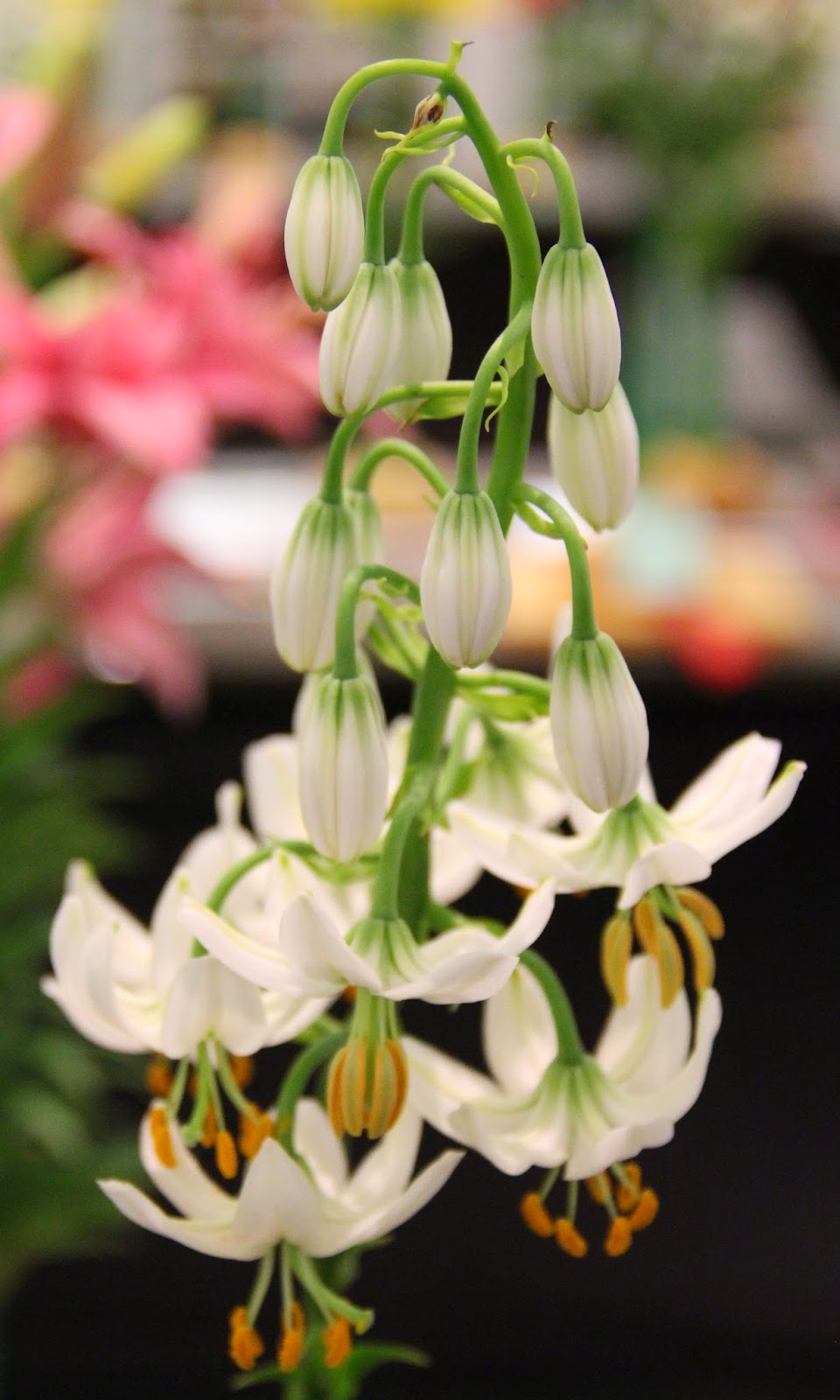
Highly adaptive plants these lilies present a marvelous natural geometry, emerging from warming soils as spherical domes the foliage emerges as rosettes of whorled leaves elongating into ascending towers topped with nodding buds which unfold into a symmetrical candelabra of down-facing (turk’s cap) flowers.
 
I have written about martagons in past postings as great shade garden companions for cold climates. All parts of martagon lilies are of great beauty.
 

It was a very good year for martagon lilies. They were gorgeous in my garden, the bloom season weather was fine, flowering lasted for weeks. I also photographed an NALS, North America Lily Society (www.lilies.org) show sponsored by the North Star Lily Society, (www.northstarlilysociety.com) in Bloomington MN. The show displayed over 100 martagon spikes, many seedlings, mostly from Canada.
 

Earlier in March I attended a talk Martagons: The Toughest Lilies of Them All” by Dr. Ieuan Evans. It was informative to hear of his method of breeding.  (See the NSLS site) I have used the process outlined by E. Eugene Fox in his book Martagon Lilies which was available through NALS. I used this process for myself and Hartle-Gilman who sold through Faraway Flowers. Today; Doc Gilman has passed away, Jan Hartle had a stroke and Faraway Flowers has discontinued business. The current owners of Hartle-Gilman have sold bulbs through master gardener plant fairs throughout Minnesota and wholesale to NSLS. At one time this collection was one of the largest in North America.
 Photos from the show, most are unnamed seedlings.


Sunday, July 13, 2014

Cacti and succulents

A few weeks ago the Minnesota Horticultural Society had an open house. In the drizzling rain I met Dennis Hoidal a wholesaler of cacti and succulents. I bought a few plants to add to our small collection and made an appointment to visit his greenhouses. My wife Mashell and I have a growing fascination with these plants, their exotic sculptural shapes, beautiful flowers and easy care are very appealing.


Dennis makes selections for sale.
Dennis began growing his passion in the 70s after giving his newlywed wife three cacti for their barren apartment. Today he has a large succulent greenhouse filled to overabundance. He also has a newer cacti greenhouse filled with rows of prickly beauty.

As we approached the first greenhouse I remarked about the large Golden Barrel Cactus and the flowering opuntia, commonly called prickly pear, or desert rose growing along the south wall. While the opuntia wintered outdoors the Golden Barrel were potted and wintered in the greenhouse. The opuntia were flowering in shades of yellow and rose pink.

Inside the succulent greenhouse (cactus also) was a fabulous array of exotic plants some were familiar, I had collected haworthia at one time, many were unknown to me or had such variety of color and form I had not encounter before. Sometimes my sight was overwhelmed, they all shouted "look at me!" I had asked Dennis if we could purchase a few. Mashell kept selecting the most rare and expensive, which Dennis would not let go, she has good taste!


To walk into Dennis's greenhouses is to walk in a world of odd and striking colors textures, and forms. An exhilarating step away from fields and forests.

Blooming Prickly Pear
Haworthia


Exotic shape

Beautiful color
Prickly texture
Incredible variety of form
Lets not forget height.
Sculpture
Bizarre and colorful
Silver blue for your windowsill
Summation to exotic beauty

Monday, June 9, 2014

Breeding and landscaping with Siberian Iris.

Spring notes


Emergence
After one of the worst winters ever recorded spring has alternated between cold and wet, hot and dry, returning to cold wet conditions. Temperatures moderated to seasonal fluctuations with sporadic heavy rains. After dry conditions in fall and wacky weather conditions this spring many mature clumps of Siberian iris are showing distress. Short stature, bloom within foliage, sometimes near ground level, these are two symptoms of concern.

Rock garden siberian iris
Classic blue-violet
I have been playing close attention to a seedling which germinated in my rock garden three years ago. Siberian Iris are wet meadow plants, mature plants can have drought tolerance. The rock garden is converse environmental conditions, at the edge of the garden and bracketed by a stone sidewalk the heat can be extreme. This Siberian Iris seedling has thrived in this alien environment and flowered this year. The plant with large blue-violet flowers is elegant, the flower form is classic. Overall the flower is not exciting, but heat and moisture tolerance could have breeding potential, it could help increase the southern range of Siberian Iris. This ability to prosper needs further testing and also propagation to ensure it can convey these traits to offspring.

We may also learn something regarding landscaping with Siberian Iris. This seedling is out of scale in a rock garden. In a border this tall plant could fix the middle ground and be the major focus of a late spring garden.

Some Siberian Iris have attractive basal coloring but in my estimation the base is a weak focal point. A wet meadow companion could cover the base. Molinia caerulea ‘variegata’ can mask the base and would also provide variation in foliage, and expand the season of interest. Molinias are native companions to Siberian species.  When the sibs are blooming this Molinia forms a low clump. As the bloom season ends Molinias create tall racemes which reach to the sky providing a tall contrast.

Another native perennial companion are Trollius which thrive in the same meadow conditions of Europe and Asia. I prefer the asian species which show honey petals versus the globe flower of European species and hybrids. The orange or yellow flowers, palmate foliage on a two foot plant are wonderful contrast in color and form. Trollius ledebourii, asiaticus, ircuticus, riederianus and kytmanov can create fields of color with Siberian iris interspersed or as accents in fields of iris.

I encourage my readers to please comment on this article. What companions do you use with your Siberian Iris? I would also love to hear of your experience with Trollius. Please include photos and I will make comments and photos into an edited posting.


Trollius chinensis