Monday, March 18, 2013


Cedar Waxwing

One of our favorite garden moments happened last October. We all hope to attract wildlife to our gardens and last fall we enticed one of my favorite birds to enjoy a sprinkler bath. A flock of waxwings migrating south stopped in our plum, they shook the dust off on a hot dry morning.


Saturday, March 16, 2013


Siberian Iris
Seed germination

How to improve Siberian Iris seed germination

Siberian iris seed requires cold stratification, a chilling and drenching which removes enzymes which delay germination. This can be accomplished by sowing seeds in pots and burying the pots to the rim in the ground over winter, frost and rainfall soften the seed coat. This nearly natural process is not completely effective and may require several winters to achieve full germination of viable seeds. In the process the seed itself may loose viability. 
 

The artificial process described below improves the percentage of seed germination; generally well above 85%, in the first year.

I collect the mature seed pods as they begin to split open in fall.  I store the collected seed in marked envelopes, one for each cross, and let the seed dry in envelopes, placed in a cool dry location until January. Watch for fungus on the drying seed.

In January, I encase the seeds from each cross into nylons cut into squares and bundle with a color coded twist tie or rubber band. The bundles are stored in margarine containers (typically I mark the container with the crosses in). I fill the container with tap water to the brim and burp shut.

The containers are stored in the refrigerator for at least 120 days, generally through mid-April. Typically temperatures should be between 34° and 41°F.  The water is replaced on a weekly basis. The water is brownish-green, avoid splashing your eyes!

Bagged seed in container

In mid-April I broadcast the seed in pots or trays and move outdoors to germinate as high temperatures move from the 50s through 70s. I use a soil mix approximately 60 % peat moss with garden soil, planting the seed just below the surface. I water frequently and sprinkle more peat moss over exposed seed.    

To get an additional jump on the growing season I sometimes start the process earlier and germinate seed under grow lights beginning in March.

Another approach after cold stratification is to sow seed in small pots which are bagged with pieces of fruit. The ripening fruit releases ethylene gas which aids in germination.

When the seedlings are 6 to 8 inches tall they are transferred to the garden.  Space the seedlings roughly 8 to10” apart. Some plants will bloom in the second year but nearly all will bloom in three years.

Seedling blooming two years from planting
 

Saturday, March 2, 2013


Hosta
Hosta garden

Shade gardens

Hosta companions

Hosta gardens are ubiquitous in my region. In the last forty years there has been a tissue culture explosion of hybrid cultivars available to gardeners. Large, tall living sculptures and tiny obscure thumbnails can grace the shade. An explosion of textures, leaf colors and forms can transform that shadow place turf cannot control.
There are design elements and companion plants that can spice up your hosta garden. Hosta are building blocks, framework to building an effective shade garden. Many times that is where gardeners stop, the house is framed, but little siding is added to complete the work. Without companions the foundation can be solid to the point of boring, mundane green.

Changing texture
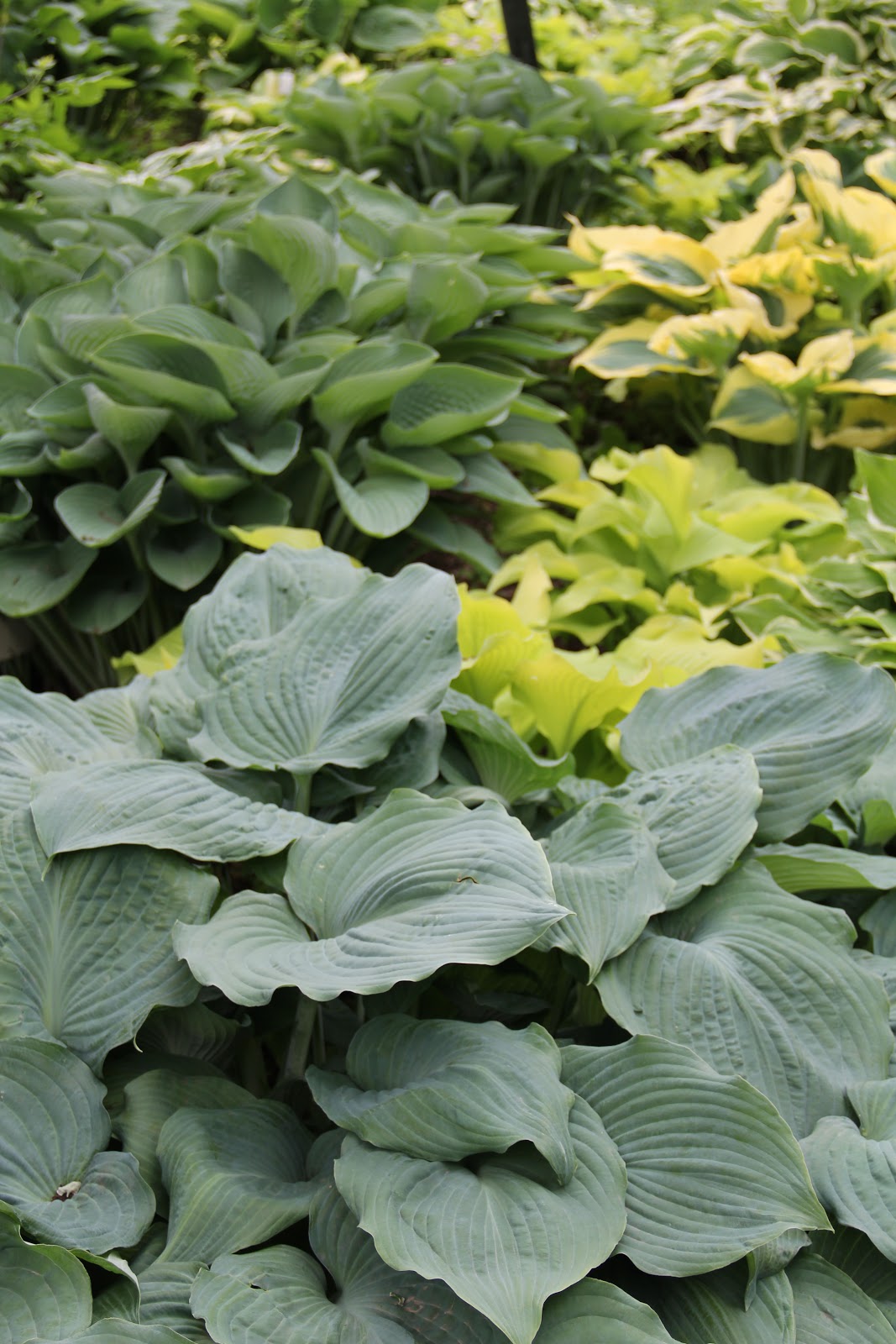
Occasional contrasts of color, texture and shape backed by a solid mass are often very effective methods of painting for the eye. An excellent method is to contrast the prominent feature of a plant in mass with another variety. An example; tall blue-green Hosta nigresens with a yellow-green variegated variety.

Contrasting masses


Blue-green mass with contrasting accents - variegation
Adding tall companion plantings will add an element of structure and succession to your glade. I will add martagon lilies, thalictrum and cimicifuga for color and height. All are long living shade lovers. Each blooms in a different season and has contrasting foliage form and color.
Thalictrum flowers and foliage light and airy


Cimicifuga foliage, blooms in fall

Martagon lilies can be six feet tall

I include Iris cristata in groups between hosta groupings for spring color and contrasting foliage. This early blooming iris provides an opening curtain to hosta groupings unfurling act. Their colonies of vertical foliage provide contrasting form amidst the lateral growth of hosta clumps.  

Contrasting foliage Iris cristata colonies
 
Seek out these companions this spring and watch them transform your shadows.
Please comment on this article! 

Iris cristata "Powder Blue Giant"
 

Sunday, February 24, 2013


Landscaping with Iris no.1

Collector gardens

Feature iris gardens

During the last decade I have spoken on landscaping with iris, it’s time to share some of my thoughts from these presentations. The most common types of iris gardens are the collector’s garden and the feature iris garden. Most of this blog will focus on feature iris gardens.

For centuries the rainbow flower has been cultivated for practical as well as aesthetic reasons. My seminars focus on the depth of thought concerning iris and how to apply this thinking in the landscape today.

Many of my iris loving friends are collectors; selection is often made for distinctive color. Iris are displayed in beds matching their cultural needs and added haphazard as they are purchased. Many friends grow tall bearded iris exclusively, TBs all share a common form, and generally just differ in color. Hybridizers seek new colors each is introduced as an improvement or for its unique character. The display of hundreds of varieties blooming at the same time can be a spectacle. When collections bloom you can become eye weary as each plant screams “look at me”! Nothing wrong with this just misses the full potential of the rainbow plant.


Look at me!
The feature iris garden focuses on bearded iris in mass. By using all sizes of bearded iris you can achieve over a month of bloom. The little ones; Miniature Dwarf Bearded (MDB) bloom first followed by Standard Dwarf Bearded Iris (SDB) sometimes just a week later, these iris can create a colorful border. MDBs usually have single buds and provide a short burst of bloom.  I use these as accents surrounded by SDBs, with multiple buds which fill out and define the gardens edge. 
SDBs as edger
I mass a single cultivar, often more than a dozen, aside complimentary colored iris. One theme is to use warm colored plants together. An example; yellow, orange and white some solid color (self) massed together with a few bicolored varieties.

Intermediate Iris
Intermediate Bearded Iris (IBs) are blooming in my garden in late May, after SDBs, before Border Bearded (BBs) and Tall Bearded (TBs) Iris.  Also intermediate in height they provide a middle ground to then stage a large display of TBs central to the entire garden. IBs are excellent garden plants, able to withstand the wind and weather which bend and break TBs. They can act as a windbreak for their bigger brethren.

Midsummers Night Dream IB
Tall Bearded Iris climax the season and garden. The largest bearded iris class, TBs are the last to bloom. Their size will dominate the garden, a backdrop to that which has passed beforehand. Color combinations are endless.

Tall Bearded Iris, the background
Good grooming of spent flowers, weeds, broken or diseased material is essential to successful presentation of the next group yet to bloom. Spacing to carry out maintenance is critical, depending on the size of the garden area, pathways may become essential.


This type of iris garden will require many classes, numerous varieties and individual iris. Plants can come from a collection or from smaller polychrome boxes. These boxes can be used to trial bloom time and color coordination. They can also be used to trial combination plants which would carry the rest of the growing season. Annuals, for example, can be effective to minimize weeds and cropped to let iris rhizomes bake in the sun.

Bearded Iris prefer quick draining neutral to alkaline soils. Rhizomes rot in damp soil, in northern climes beds can be raised with sandy loam.


The themes can be endless; all warm colors, all cool colors, or one of each. A progressive rainbow throughout the bearded iris season. Garden shape can be a roundel, or oval, a rectangle to walk around or a border along a wall.
  

A feature iris garden can demonstrate the full variety of size and color in the bearded iris classes. Massed plantings of iris show the maximum potential of the rainbow flower. 

Sunday, February 3, 2013

Orchids

St.Paul Winter Carnival Orchid Show

More eye candy.

Cattleya, Laelia, Brassia interspecies hybrids.


Phalaenopsis hybrids.


Cymbidium hybrids; started collecting these in the early 80s, have always wanted a greenhouse full of cymbidium species and hybrids. 


Found this butterfly beside the rainforest trail.

 
Hope you have enjoyed this photos!

Saturday, February 2, 2013

Siberian Iris breeding
After growing Siberian Iris for a few years I decided to breed my own seedlings. I believe plant breeding is the penultimate endeavor for gardeners.
I set goals when I began my Siberian Iris breeding program.
Develop:
Taller cultivars above 48”
Small cultivars between 8” and 18”
Bicolor Siberians
Silver or grey cultivars
Lite blue cultivars
With these breeding goals I set more; read everything I could in regard to breeding strategies, Siberian Iris culture and genetics. I purchased the SI cumulative check list which lists all registered Siberians with descriptive information including parents. I found a wealth of information in The Siberian Iris, magazine of the Society of Siberian Iris, The World of Irises, published by AIS and Dr. Currier McEwen’s book The Siberian Iris.     
In the spring I made crosses, prepared with knowledge, I set about acquiring practical experience. I practiced my techniques and opened my checkbook to purchase plants to fit my strategy. I also studied to become an American Iris Society Garden Judge, to hone my critical eye.
I have now been breeding for over a decade, my efforts have been uneven as my life has had considerable issues, such as nearly dying five years ago. I still make yearly crosses and I have enjoyed triumphs and failures. Each spring I see new children I now share with my bride; it’s wonderful to create something new! 
 

First efforts, big flouncy light blues, big flowers, tall plant
 
Another with darker blue shoulders, over 48" tall
Peach pink
SummerChase Advent, First intro/registration
Stopped with bicolored falls
Nothing exceptional with large yellows
 
Dwarf Siberians are on! Light blue, large flowers, 10" tall

 
Another dwarf light blue, smaller delicate flowers, doesn't it look like a Standard Dwarf Bearded Iris!

Beautiful form, cut up by hail. blooms at 12" another light blue.


This dwarf also has promise 

Sunday, January 27, 2013

Orchids

St. Paul Winter Carnival Orchid Show


Every year my wife and I travel to Como Zoo Conservatory in St. Paul in the dead of winter to take a breath of the tropics. The morning temp started at -5 below zero and by noon we were in a tropic rainforest! An added benefit was the St. Paul Winter Carnival Orchid Show, camera in hand we took pictures of some of our favorite orchids on display at this judged show. 


A beautiful small cymbidium


Mashell and I both want this Ascocentrum species for our living room.


A classic phalaenopsis
 
 
Paphio hybrid
 
Need a break from winter doldrums?
Visit your local winter orchid show!